Evidence and method
Sources, sample and coding
Sources. Public Google Play reviews for Monzo and Starling, and published Financial Ombudsman Service decisions covering a wider set of UK providers. The two strands are not the same provider set and are reported separately.
Scope. 450 reviews were screened. The central comparison uses 74 like-for-like low-rated complaints, 25 verification-related and 49 other. Ombudsman decisions were read qualitatively alongside them. The counts are not additive and do not represent 450 individual people studied.
Inclusion. Cases include freezes and closures that occurred after an account was opened, not only account-opening rejections. Where that distinction matters it is kept rather than collapsed into one claim.
Coding. Each complaint was coded for journey stage, failure type, and whether it described opacity and/or absent recourse. Five recurring failure types emerged: document rejection, biometric or liveness failure, waiting and uncertainty, opaque rejection or freeze, and exclusion with denied recourse.
Statistics
Opacity and/or absent recourse: 13/25 (52%) versus 9/49 (18%). Continuity-corrected χ² = 7.43, p = .006. Odds ratio 4.8, 95% CI 1.7 to 14.0. Cramér’s V = .32. Fisher’s exact agrees to the same rounded p value.
An odds ratio of 4.8 describes the odds of a complaint being coded this way. It does not mean 4.8 times as many customers lost trust.
Intensity: Mann-Whitney U on star rating p = .33, and on VADER sentiment p = .69. No difference was detected. With this sample only a large difference would have been detectable.
Limitations
- App reviews over-represent very satisfied and very dissatisfied users.
- The 25 versus 49 comparison could reliably detect only a large intensity difference.
- Observational design. The research identifies association, not causal effect.
- Random re-coding by the same coder produced Cohen’s κ = .58. This is not independent inter-rater reliability.
- English-language Google Play data, collected in a defined window.
- Ombudsman cases are escalated disputes, not typical onboarding experiences.
- Several cases involved vulnerable customers or reasonable-adjustment failures. The sample is far too small to support any claim of disproportionate impact, and none is made.
Source pages from the dissertation
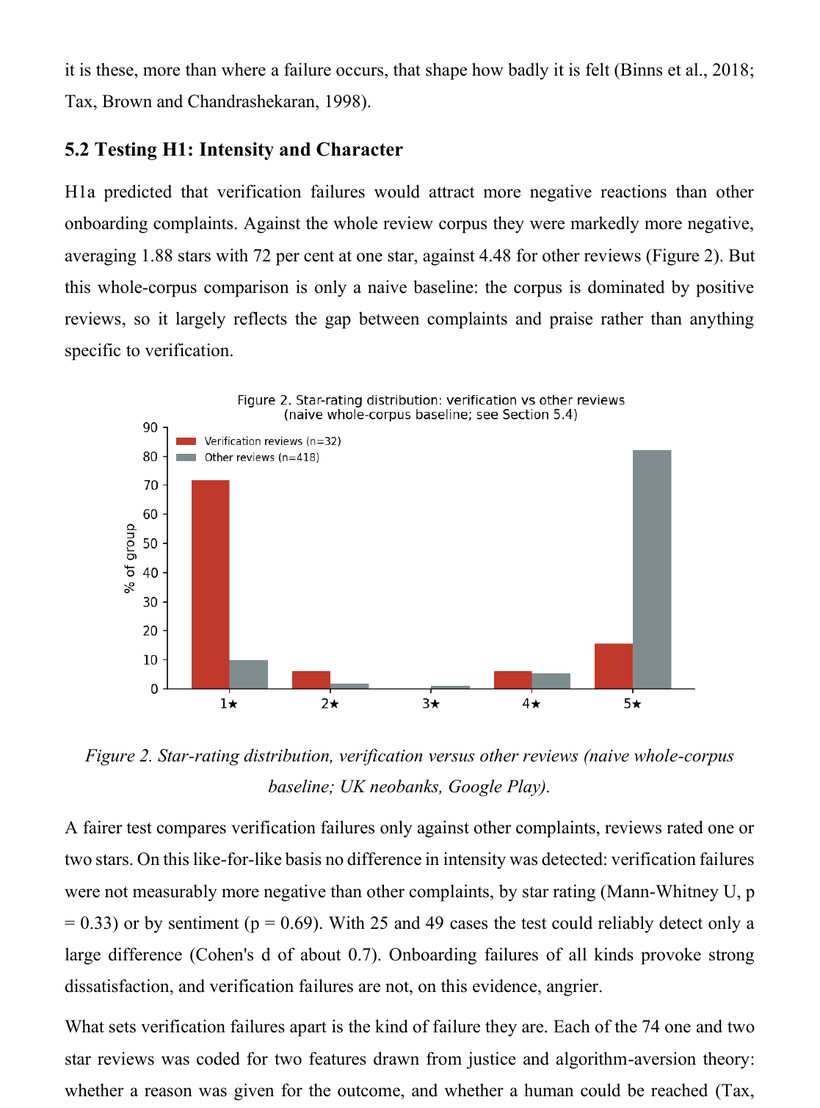
No detected difference by rating or sentiment.
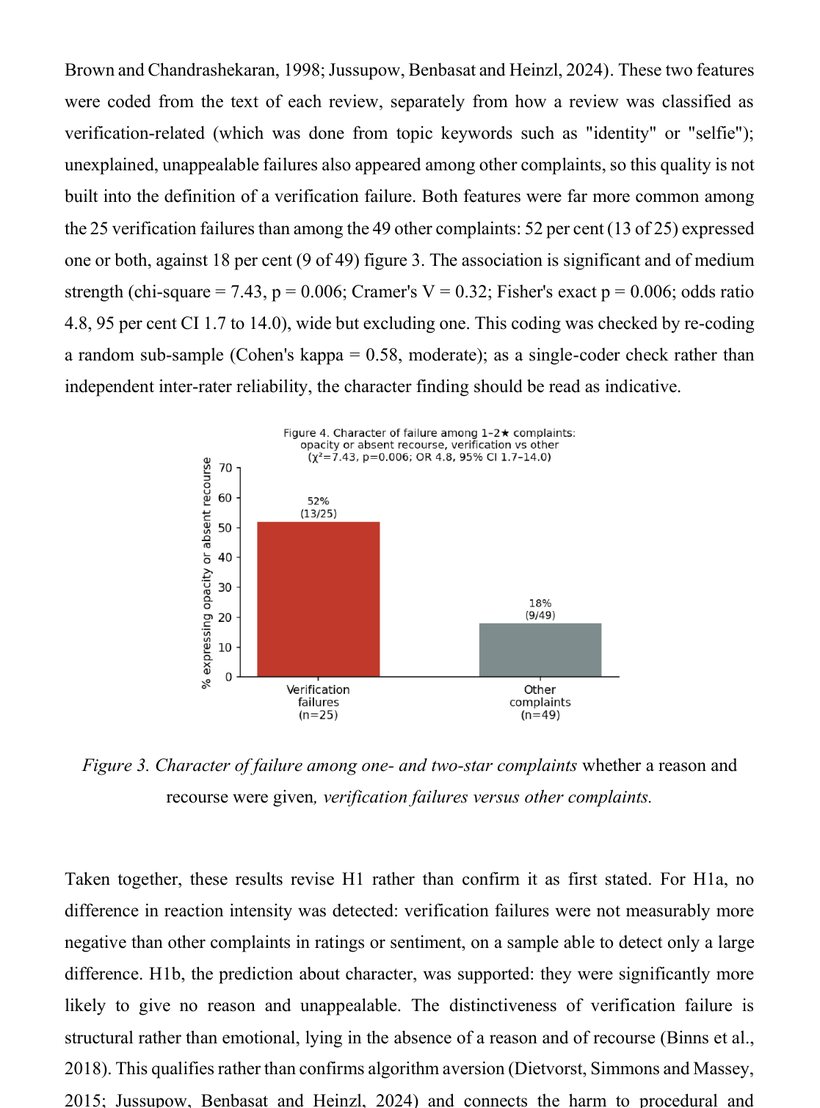
52% versus 18% opacity or absent recourse.
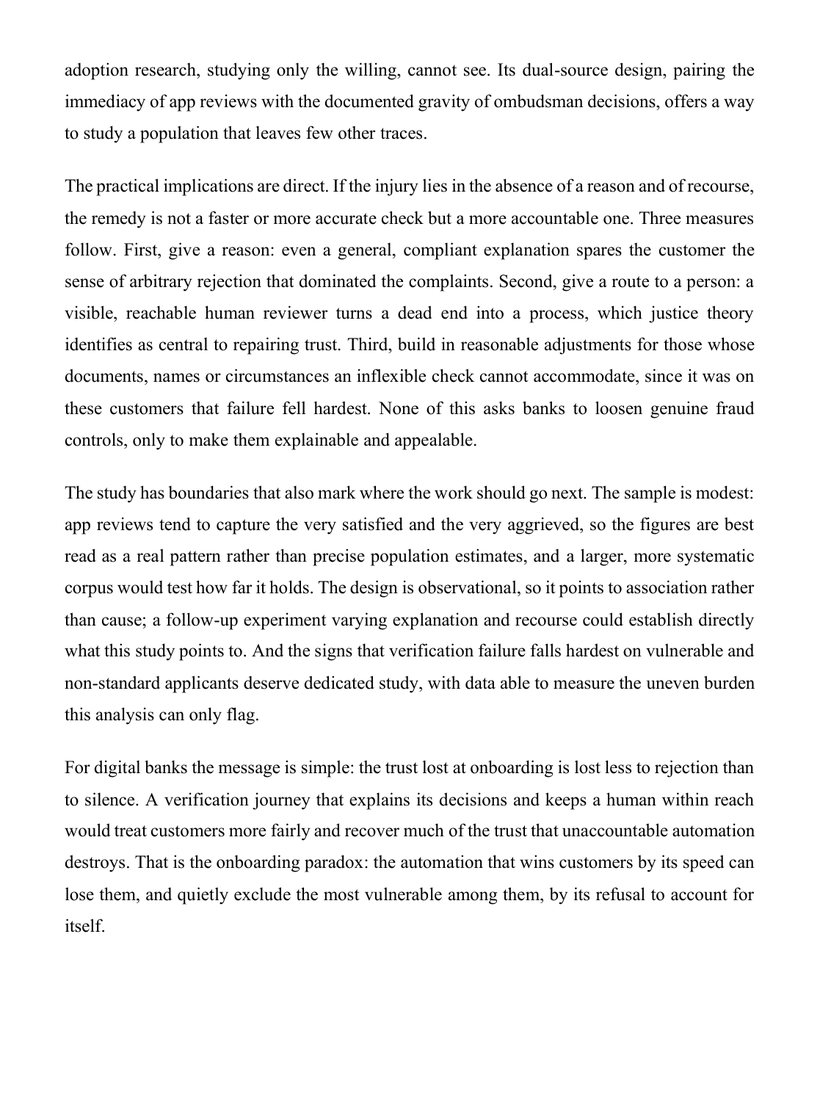
Explainability, human review and reasonable adjustments.